The goal
Army & Outdoors wanted to lift average order value (AOV) and, ideally, conversion rate. The hypothesis is a well-established one in ecommerce: offer a free gift once the cart crosses a threshold, and show customers exactly how close they are to unlocking it. Someone who's $63 away from a free gift will often add the item that closes the gap.
What the customer sees
Below the threshold — a progress bar and a precise "how much more to go" message:

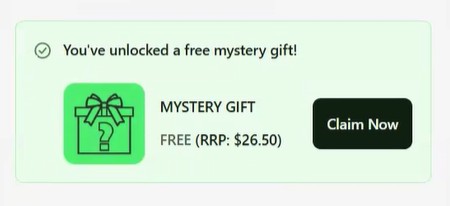
Once the threshold is crossed — the gift unlocks with a clear confirmation and a "Claim Now" action:

Two details that matter here:
- It's framed as a "mystery gift". A wrapped, unknown gift converts better than a named product — curiosity plus the feeling of getting something free.
- The RRP is shown. "FREE (RRP: $26.50)" anchors the value. The customer knows exactly what they're getting for free, which makes the "spend a bit more to unlock it" maths feel worth it.
(The dollar figures in these screenshots are from an older capture on the US store. The threshold and gift value are configured per store and per currency — NZ, AU, US and EU each run their own numbers.)
How it was built — honestly
Straight up, the same way I am about the MCP server elsewhere on this site: this extension was built using Claude. I identified what was needed — the mystery-gift mechanic, the threshold logic, the edge cases that make it safe in a live checkout (gift-card prevention, duplicate prevention, threshold-drop handling) — and I directed Claude to build it, tested it against those cases, and shipped it into a production Plus checkout in four currencies.
I'm telling you this because the alternative — claiming I hand-forged a Preact checkout extension from scratch — would be a lie you'd eventually find out, and it would undermine every honest number elsewhere on this site.
The skill that matters in 2026 isn't typing every line. It's knowing what the extension had to do, recognising when the output was subtly wrong, knowing which edge cases break a checkout, and getting it live correctly without the conflict-of-interest padding most agencies bill for. Where the work genuinely needs deep hands-on engineering — the multi-store sync, the webhook reliability patterns, the years-stable production systems in my other case studies — that's hands-on work I've done and own. Different problems, different approaches. Knowing which is which, and being honest about it, is what you're actually hiring.
What it does
- Threshold-triggered mystery gift — when the cart subtotal crosses the configured threshold, the free mystery gift is applied at checkout.
- Progress bar + exact gap message — before the threshold, the customer sees "You're only $X away from unlocking your free mystery gift!" with a visual bar. This is the part that actually drives the AOV behaviour: it turns "spend more" into a concrete, visible target.
- RRP anchoring — the gift's recommended retail price is shown so the customer perceives the real value of what they're unlocking.
- Gift-card prevention — gift card purchases don't count toward the threshold and don't trigger the gift. Without this guard, someone could buy a gift card to cross the threshold and extract a free physical product — a margin leak that's easy to miss until it's abused.
- Duplicate-gift prevention — the gift is applied once and only once, even as the customer edits their cart, removes items, or the checkout re-renders.
- Threshold-drop handling — if the customer removes items and the subtotal falls back below the threshold, the gift is removed again and the progress bar reappears. The state always matches the cart.
The technical bits worth noting
- Checkout UI Extension, not a cart-page hack — this runs in Shopify's actual checkout (Plus-only), the highest-leverage and most locked-down surface on the platform. It's also where mistakes are most visible and most costly, so the edge-case handling matters more here than almost anywhere else.
- State-change resilience — Shopify checkout extensions re-evaluate on every cart mutation. The gift logic is idempotent against that: the correct state is reached no matter how many times the extension re-runs.
- Edge cases are the whole job — the happy path ("cart over threshold, add gift") is trivial. The actual engineering is the guards: gift cards, duplicate prevention, threshold-drop removal, per-currency thresholds, and never breaking the checkout itself.
Honest about the result
The extension works and has run in the live checkout across stores. What I won't do is quote you an AOV uplift percentage, because I don't have a clean, attributable measurement of it in front of me — and inventing a number would undermine everything else on this site.
What's true: the mechanic is well-established, the implementation handles the edge cases that make these promotions safe to run, and it's been live in real Plus checkouts in 4 currencies. The honest framing of expected impact is "this is a proven AOV lever when the threshold is set correctly relative to your existing AOV" — not a guaranteed number I'd put in writing without your data in front of me.
Why this matters for your store
Free-gift-over-threshold is one of the most reliable AOV levers available, but only on Shopify Plus (the checkout is locked on lower plans). Most stores that try it do it badly — the gift gets applied twice, gift cards trigger it, or the progress logic breaks on cart edits and the whole checkout feels janky. Those bugs don't just cost margin; they erode trust at the exact moment someone is paying.
The value isn't "add a free gift" — anyone can attempt that. It's building it so the edge cases are handled and it never breaks the checkout, in every currency you sell in. That's the difference between a promotion that quietly makes money and one that quietly loses it.