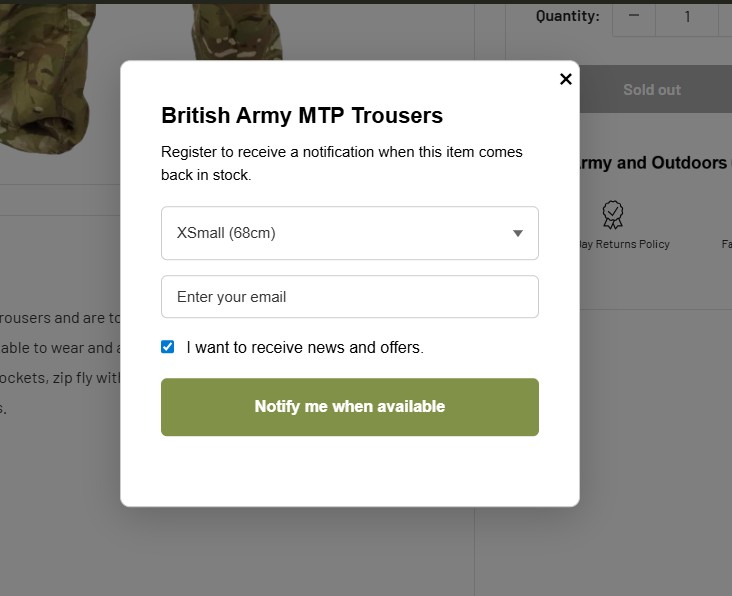
The popup
The current production popup on Army & Outdoors product pages:

Variant picker, email capture, marketing opt-in, "Notify me when available" — all in a familiar pattern customers already understand.
The backstory — why we built this
Army & Outdoors used to run a back-in-stock notification app from the Shopify App Store. The flow was familiar: customer lands on a sold-out product page, clicks an "Email me when available" button, fills in the popup with their email and variant choice, and the app sends them an email when stock returns.
It worked fine. Until one day, it didn't.
The app stopped sending notifications. No error message, no warning. Customers kept submitting their emails. The app kept "accepting" them. But the notifications never went out.
We tried to contact the app developer. Email — no response. Phone — never picked up. Support form — silence. Weeks went by with no contact.
By the time we figured out the scope of the failure, we estimate 10,000+ notifications had been silently dropped. Customers who'd told us they wanted these products had been ignored. We had no way to recover the list — it was locked inside the broken app.
That was the day we decided we'd never depend on a single-point-of-failure third-party app for this kind of customer commitment again. I'd build it in-house.
What I built
The new popup mirrors the familiar UX so customers don't notice anything changed — but the entire backend is ours. Direct Klaviyo integration, no third-party app in the middle.
How it works for the customer
- Customer lands on an out-of-stock product page
- Clicks "Email me when available" (button replaces the disabled Add to Cart)
- Popup opens (scroll-locked, header hidden to avoid z-index issues)
- Customer selects the variant they want notified about (e.g., "XSmall (68cm)")
- Enters email address
- Optional checkbox: "I want to receive news and offers" — opts them into the marketing list at the same time
- Clicks "Notify me when available"
What happens behind the scenes
- Customer is subscribed to the Klaviyo back-in-stock list with the specific variant ID as a profile property
- If the marketing checkbox is ticked, they're also added to the main marketing list
- When that exact variant goes back in stock (inventory webhook fires), Klaviyo triggers the back-in-stock email automatically
- Klaviyo flow handles the email — including throttling, deliverability, click tracking, all the usual marketing hygiene
The technical bits worth noting
- Direct Klaviyo API integration — no third-party app, no middleware that can fail silently. If the API call fails, we see it immediately in our error log.
- Scroll-locking done properly — body scroll locked while the popup is open, with no layout shift (the common iOS Safari gotcha) and no double-scroll mess.
- Header z-index handled — the sticky site header is hidden when the popup opens, so there's no fighting for visual layers.
- Subscription confirmation — the customer sees a success state in the popup itself, not a page reload that loses their place on the product page.
- Variant-aware — Klaviyo profile gets the specific variant ID, so the back-in-stock email triggers only when THAT size/colour returns, not on any variant of the parent product.
The result — 3+ years, zero failures
The custom popup has been running in production at Army & Outdoors for approximately 3 years. Every back-in-stock email has been captured and sent. No silent failures. No vendor lock-in. No 10,000-email gap.
Customer demand for restocked products is one of the highest-converting touchpoints in ecommerce — someone has literally told you they want this product. Losing those signals to a broken app is losing real revenue. Building it in-house took a few days. The peace of mind has lasted years.
Why this matters for your store
If you're running a Shopify store on someone else's notification app and you haven't audited it recently — check it. Send yourself a test notification. Confirm the email actually arrives. Many of these apps have shipped and been abandoned by their developers, and the failures are silent.
If you want to remove the dependency entirely, this kind of in-house popup is a 1?2 week build with a clean Klaviyo connection. Once built, it doesn't break. I've run mine for 3 years and counting.